
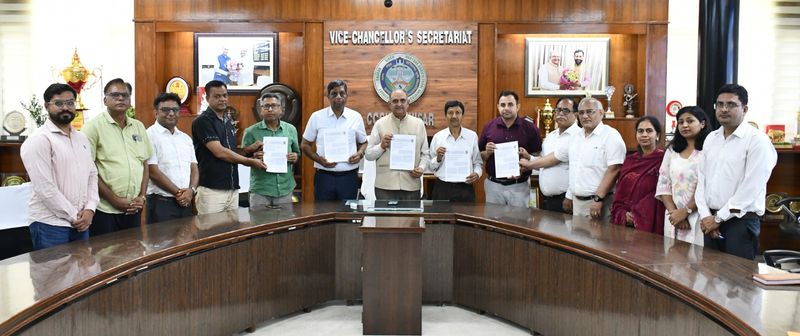
Scientists at Chaudhary Charan Singh Haryana Agricultural University (HAU) have identified a new pathogen, Fusarium proliferatum, responsible for the devastating wilt disease in strawberry crops. This marks the first confirmed report of the pathogen causing strawberry wilt disease in India.
Following the finding, HAU has initiated efforts to develop effective disease management strategies. Researchers have already evaluated several fungicides and bio-agents under laboratory conditions and plan to conduct field trials during the upcoming growing season. Scientists are optimistic about developing an effective control strategy soon.
Vice-Chancellor B. R. Kamboj informed that the university’s focus has been on monitoring and disease management of the crop. He said it is important to identify emerging threats in agriculture at an early stage. There is a need for continuous monitoring of disease outbreaks and rapid implementation of field-level control measures, he added.
“Strawberry cultivation is often challenged by various biological factors, with wilt disease being a major concern. This finding highlights the urgent need for robust surveillance and management strategies to protect strawberry production,” the Vice-Chancellor said.
Director of Research (DR) Dr Rajbir Garg said the findings have been accepted for publication as a first research report in the journal Physiological and Molecular Plant Pathology, published by Elsevier, a leading international scientific publisher specialising in science, technology and medicine.
The publication formally recognises the disease report, making HAU scientists the first researchers in India to identify and document this pathogen as a cause of strawberry wilt disease.
Lead researcher Dr Aadesh Kumar said that efforts are under way to better understand the disease outbreak and develop targeted measures to minimise its impact on strawberry production.
The research team included scientists Anil Kumar Saini, Roomi Rawal, Rakesh Kumar, K. C. Rajesh Kumar, Sushil Sharma, Vikas Kumar Sharma, Yogesh Kumar, R. P. S. Dalal, Prince, Indu Arora, Rakesh Gehlot and PhD scholar Shubham Saini.
