
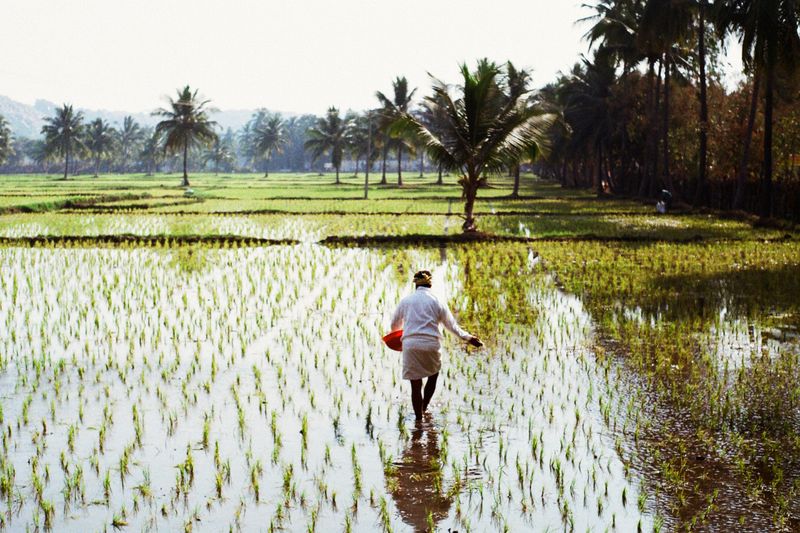
Asia accounted for more than 90 per cent of the world’s total greenhouse gas emissions from rice paddies during 2001-2020, with Southeast Asia contributing the largest share, according to a study published in the journal Nature Food.
The study found that greenhouse gas emissions from rice paddy fields have doubled since the 1960s to the equivalent of 1.1 billion tons of carbon dioxide annually.
Researchers, led a team from Boston College, US, said practical farm changes could cut methane emission and support global climate targets without reducing food production.
“Our goal was to understand the full climate impact of rice systems — not just methane, but all major greenhouse gases together — and to identify realistic pathways for mitigation,” lead author Hanqin Tian, professor of earth and environmental sciences, Boston College, said.
While rice feeds more than half of the world’s population, it has a growing climate footprint with flooded paddies emitting methane and nitrous oxide, two powerful greenhouse gases.
The researchers combined a machine learning algorithm trained on more than 21,000 field observations, a process-based ecosystem model, and a global meta-analysis.
The team quantified total emissions, identified key drivers such as land expansion and residue management, and evaluated how future mitigation strategies could contribute to climate targets — including methane reduction goals under international initiatives.
The researchers said that as rice farming intensifies worldwide, understanding its methane footprint — and how to reduce it without threatening food security — has become a global priority.
Methane is a major contributor, particularly in regions such as East Asia, while Africa is emerging as a new hotspot due to expanding rice cultivation, the team found.
This study provides the most comprehensive global assessment of rice-related greenhouse gas emissions to date, covering methane, nitrous oxide, and soil carbon changes from 1961 to 2020, Tian said.
“Asia dominated global rice paddy soil GHG (greenhouse gas) emissions, contributing 90.2 per cent of the global total during 2001-2020 and 61.1 per cent of the global increase relative to 1961-1980, with Southeast Asia accounting for the largest share,” the authors wrote.
Annual global rice cultivation was found to range from 397.4 million acres in 2015 to 426 million acres in 2024.
Two dominant drivers were identified behind the six-decade surge in emissions — an expansion of rice cultivation, particularly in developing regions, which has increased total emissions globally, and an intensified residue incorporation, where crop residues are returned to flooded soils, boosting methane production.
Despite increasing emissions, the study highlights a clear opportunity — improved farm management could reduce emissions by about 10 per cent without compromising yields.
Key strategies include optimising water management to reduce methane formation, reducing an excessive return of residue to soils, and improving nitrogen fertiliser efficiency.
“These are practical, scalable solutions that farmers can adopt today. They offer a meaningful pathway for agriculture to contribute to near-term climate targets, including methane reduction goals,” co-author Susan Pan, associate professor of engineering at Boston College, said.
