
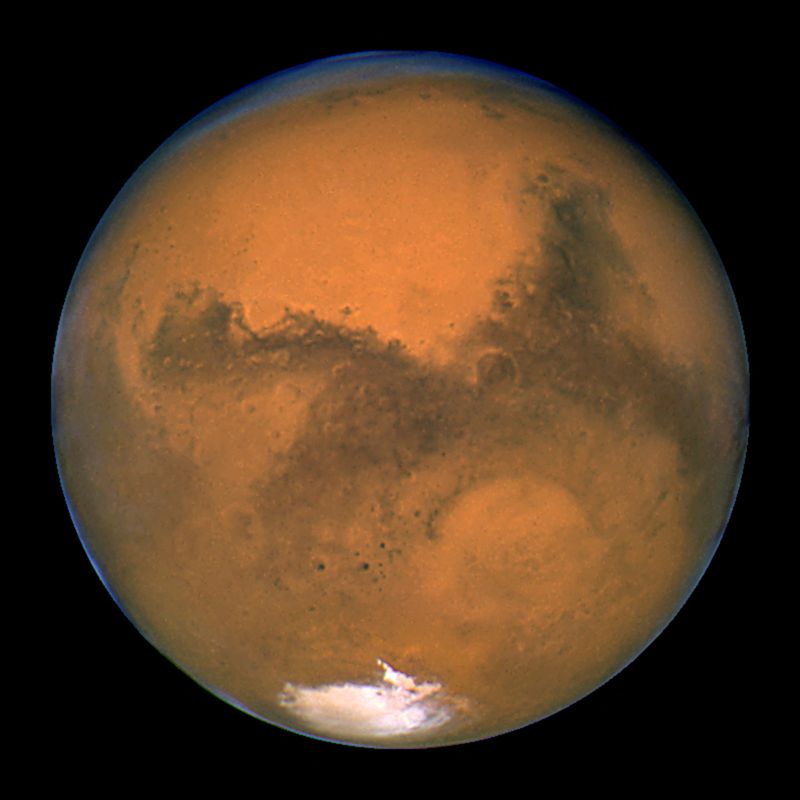
Solar winds gradually strip atmospheric particles of Mars into space in a way similar to how wind blows across the surface of water, according to a new study.
Researchers, led by those at Boston University in the US, said that while wind on Earth can generate rolling waves and vortices on the water surface, the solar wind on Mars can similarly “stir” the edge of the planet’s upper atmosphere and generate large boundary waves known as Kelvin-Helmholtz waves.
The study, published in the journal Science Advances, used observations from both the NASA’s MAVEN and China’s Tianwen-1 missions.
“Mars is thought to have once been potentially habitable, with a thicker atmosphere and surface liquid water. Understanding how it became the cold, dry planet we see today is important for understanding how planetary environments evolve over time,” first author Chi Zhang, a research scientist at Boston University’s center for space physics, said.
Large clouds of plasma in Mars’ upper atmosphere facilitate a “bulk escape” of atmospheric ions.
Zhang explained that, although several mechanisms had previously been proposed to account for the formation of the plasma clouds, their origin remained unclear because direct observational evidence was still lacking.
A major challenge in connecting the solar wind to atmospheric escape at Mars was that a single spacecraft could not simultaneously measure both the undisturbed solar wind upstream and the escaping atmospheric ions near Mars.
In an earlier study published in Nature Communications, Zhang and colleagues demonstrated that simultaneous observations from MAVEN and Tianwen-1 could directly link variations in the upstream solar wind to the Martian space environment.
Building on the dual-spacecraft observations, the recent Science Advances study identified Kelvin-Helmholtz waves as a key mechanism driving atmospheric ion escape, the researchers said. They have provided evidence that the plasma clouds are generated by the Kelvin-Helmholtz waves and further showed that the process does not occur evenly around the planet.
“Instead, it is mainly observed on one side of the planet, depending on the direction of the solar wind electric field,” said Zhang.
The results establish a direct link between the Kelvin-Helmholtz waves and an enhanced atmospheric ion escape from Mars, the researchers said.
