
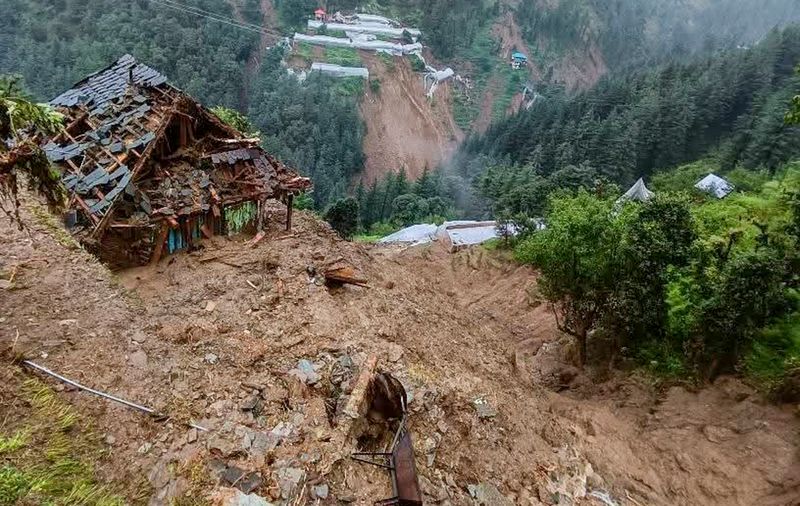
Nature’s extremes often strike without warning, and one weather event that illustrates this is a cloudburst. Within minutes, torrents of rain concentrated over a small area can overwhelm rivers, trigger flash floods and devastate communities. As climate change reshapes rainfall patterns, short-duration extreme events are emerging as one of the most pressing challenges for disaster preparedness and adaptation.
The India Meteorological Department (IMD) classifies a cloudburst as rainfall exceeding 100 mm in one hour over an area of 20–30 sq km. These events are associated with rapidly developing cumulonimbus clouds under favourable atmospheric conditions. While cloudbursts were once largely considered a Himalayan phenomenon, their occurrence in plains regions signals a wider national concern.
“Although there is no clear upward trend in cloudbursts, mini-cloudbursts — rainfall of 50 mm or more within two consecutive hours — are increasing. Unlike traditional cloudbursts confined to the mountains, mini-cloudbursts are now being reported across the Indo-Gangetic plains, the western coast and central India, reflecting the growing variability of extreme rainfall under a warming climate,” said Dr KK Gill, Principal Agrometeorologist, Department of Climate Change and Agricultural Meteorology, Punjab Agricultural University.
The Northwestern Himalaya, covering Uttarakhand, Himachal Pradesh and Jammu & Kashmir, remains highly vulnerable. Steep slopes and fragile terrain amplify the destructive potential of sudden downpours, turning heavy rainfall into flash floods and landslides. Disasters in Leh (2010), Uttarakhand (2013) and Himachal Pradesh (2024) underscore the risks.
Cloudburst-like events are also increasingly affecting the plains. Punjab, for instance, recorded 400 mm of rain in a single day in Ludhiana on August 12, 2011, causing widespread damage. Flat terrain, dense settlements and inadequate drainage make the region particularly vulnerable to flooding. Unusual snowfall in Pathankot in 2011 and hailstorms in Sangrur in 2019 further highlight shifting weather patterns, Dr Gill added.
Unlike large-scale weather systems, cloudbursts develop rapidly and remain difficult to predict. Forecasting relies on short-range nowcasting using Doppler Weather Radars (DWRs), satellites and numerical weather models. India’s radar network has expanded to around 50 operational radars, with more planned under Mission Mausam. Advances in AI-driven analysis and Multi-Radar-Multi-Sensor (MRMS) systems could further improve monitoring, said Abhishek Dhir, also from the Department of Climate Change and Agricultural Meteorology.
Safety measures during cloudbursts
Monitor weather advisories during the monsoon months.
Avoid flood-prone areas, including riverbeds and steep slopes.
Keep drainage systems clear and functional to reduce waterlogging.
Prepare evacuation plans and keep essential supplies ready.
Restrict construction in unstable and vulnerable terrain.
Strengthen community awareness to ensure a coordinated disaster response.
Cloudbursts, once viewed primarily as rare Himalayan phenomena, are now a wider national weather challenge. With climate change increasing rainfall variability, both mountainous and plain regions face heightened risks. Strengthening forecasting systems, improving infrastructure resilience and enhancing community preparedness will be critical to mitigating the destructive impact of these sudden deluges.
