
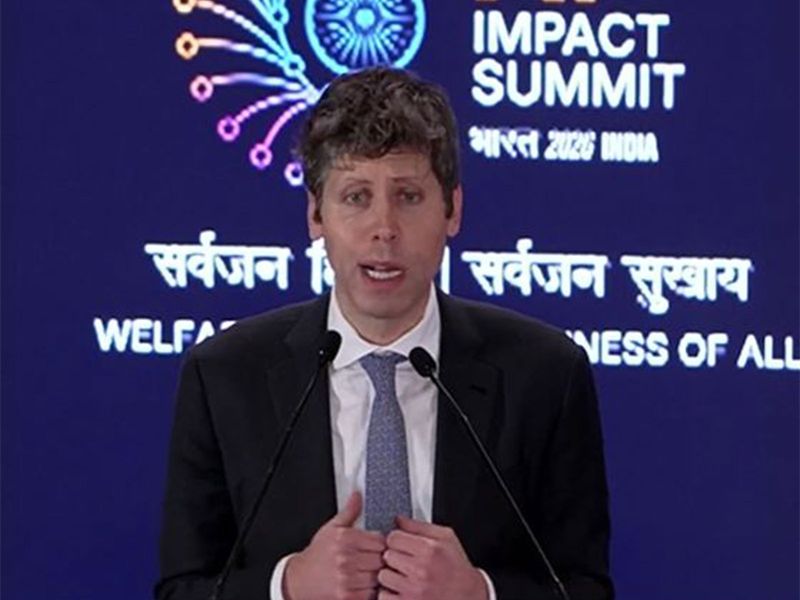
Artificial intelligence must empower people, not concentrate power. This was the central message from OpenAI CEO Sam Altman as he echoed Prime Minister Narendra Modi’s call for the democratisation of AI at the India AI Impact Summit.
In a separate panel discussion, Anthropic co-founder and CEO Dario Amodei too underlined how India could play a pivotal role in ensuring AI’s benefits reach the wider Global South.
Altman said India’s scale and democratic framework uniquely position it to shape the global AI future. “India, the world’s largest democracy, is well placed to lead in AI, not just to build it, but to shape it and decide what it is important to move quickly on,” he added.
Related news: Was confused: OpenAI CEO Sam Altman on raised fist photo
Pointing to rapid technological progress, Altman noted how fast systems were advancing. “We’ve gone from AI systems that struggled with high school-level math to systems that can do research-level mathematics now,” he said, adding that early forms of superintelligence might emerge soon. “On a current trajectory we believe we’re only a couple of years away from early versions of true superintelligence,” he said.
However, he stressed that access, not just capability, would define AI’s future. “Democratisation of AI is the only fair and safe path forward,” Altman said. Warning against concentration of power, he added, “The centralisation of this technology in one company or country can be a deeply undesirable future.”
Altman also addressed concerns around employment, saying AI would inevitably disrupt the job market, but argued that such transitions had accompanied every major technological shift. “Technology always disrupts jobs. We always find new and better things to do,” he said, adding while some current roles might become obsolete, AI would expand human capability and create new forms of work.
Altman also highlighted India’s growing adoption. “Nearly 100 million people in India use ChatGPT every week… more than a third of them are students,” he said, calling the country one of the company’s fastest-growing markets.
Bill Gates pulls out of summit amid Epstein row
Bill Gates pulled out of AI Impact Summit hours before his scheduled keynote on Thursday, as scrutiny over his ties to late financier and sex offender Jeffrey Epstein intensified following the release of US Justice Department emails.
In a separate panel, Amodei spoke about India’s importance beyond its borders. “Practices pioneered in India have historically set a standard for the Global South and helped diffuse technology and humanitarian benefits,” he said.
He outlined partnerships with Indian nonprofits and enterprises to expand AI use in education, agriculture and healthcare, aiming to “spread AI’s benefits across the Global South starting with India”.
Amodei also highlighted India’s governance role in the AI era. “India is the world’s largest democracy and can be a partner and leader in addressing the global security and economic risk of the technology,” he said, stressing collaboration on safety, evaluation and economic impact studies.
Infosys co-founder Nandan Nilekani focused on the challenge of translating technological breakthroughs into societal value. “There is this duality between the fundamental capabilities of the technology and the time that it takes for those capabilities to diffuse into the world,” he said.
