
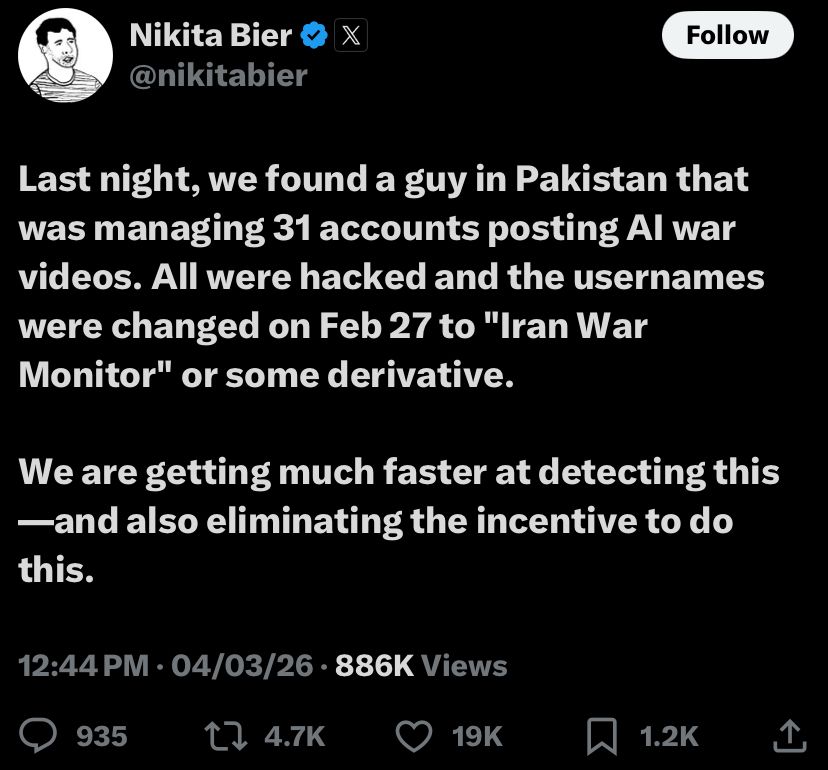
As tensions escalate between the US, Israel and Iran, social media platforms are struggling to contain a surge of AI-generated misinformation depicting the conflict. X recently revealed it dismantled a network of accounts operating from Pakistan that were posting fabricated videos of the war.
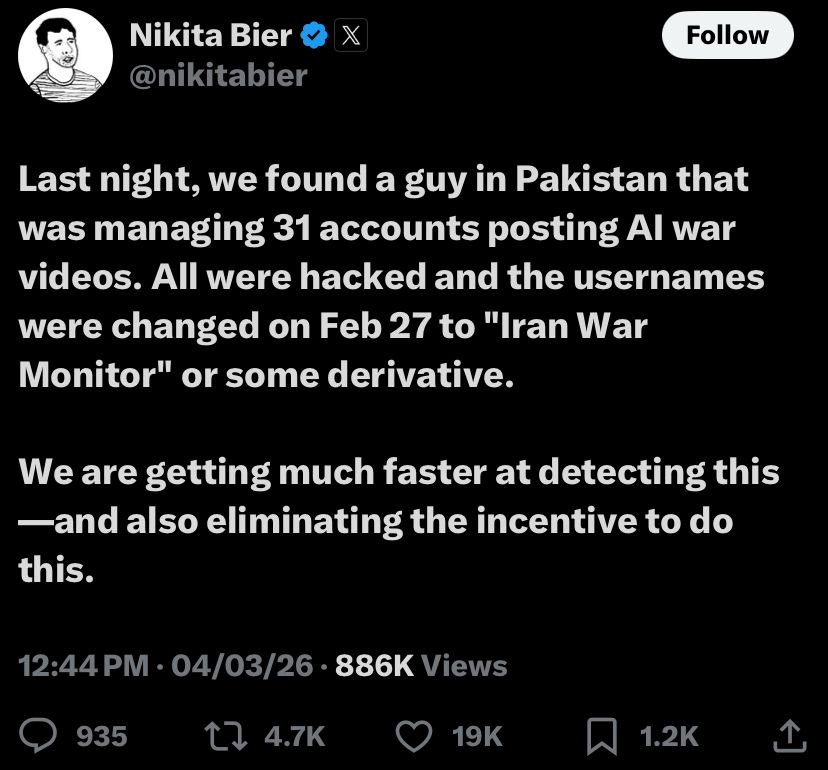
Nikita Bier, X’s head of product, said the platform identified a user in Pakistan running 31 coordinated accounts spreading AI-generated war footage. “All were hacked and the usernames were changed on February 27 to ‘Iran War Monitor’ or some derivative,” Bier wrote.
The accounts were quickly removed as part of X’s intensified efforts to detect and curb coordinated disinformation. Bier emphasised the platform is improving its speed in identifying misleading content while reducing incentives for its spread.
The revelation came after a deepfake video circulated showing an Iranian rocket hitting a ship in Tel Aviv. The account posting the clip, under the name Ahmed Hamdan, claimed to be a journalist from Gaza, highlighting the challenges platforms face in verifying user identities and content authenticity.
The surge of AI-driven misinformation occurs against the backdrop of a wider West Asia crisis, following US and Israeli strikes on Iran and retaliatory attacks. Social media has been flooded with images and videos claiming to show damage across Iran, Israel, and neighboring countries. Investigators and fact-checkers, however, warn that much of this content is manipulated or entirely fabricated.
In one case cited by the Financial Times, a satellite image circulated online, including by X’s account of Iran’s Tehran Times, purportedly showing damage to a US radar system in Qatar after an Iranian drone strike. Analysis revealed the image had been altered with AI.
While genuine satellite imagery confirmed some damage, the widely shared post was an AI-modified picture of a location in Bahrain. Despite being false, it attracted nearly one million views and remained online for more than two days.
This is not the first time AI-generated content has spread during wartime. During the 12-day Israel-Iran conflict in June 2025, several videos depicting Iranian military strength and alleged damage to Israeli infrastructure circulated online, according to a BBC report.
Pro-Israel accounts also shared misleading posts, including old protest footage falsely framed as anti-Iran demonstrations. Verification group GeoConfirmed has repeatedly flagged fake or mislabelled content in the current conflict.
A viral claim blaming a US-Israel attack on a failed Iranian missile launch at a girls’ school in Minab was debunked, though it had already amassed more than 750,000 views.
Experts warn that generative AI tools have made creating convincing fake content easier than ever. Henk van Ess, an online research methods specialist, noted that satellite imagery is particularly susceptible because most people cannot distinguish authentic images from manipulated ones.
Open-source intelligence researcher Brady Africk added that AI-altered imagery could mislead journalists and analysts tracking conflicts.
In response, X has tightened enforcement against AI-generated war content posted without disclosure. Users who fail to label AI content will face a 90-day ban from the platform’s Creator Revenue Sharing programme, with repeat violations potentially leading to permanent removal. X has also expanded its “Community Notes” feature, allowing users to add context and fact-check misleading posts.
Governments are taking note as well. In the United Arab Emirates, Dubai Police warned residents against sharing unverified images or rumours about security incidents, cautioning that violators could face fines of at least 200,000 dirhams.
