
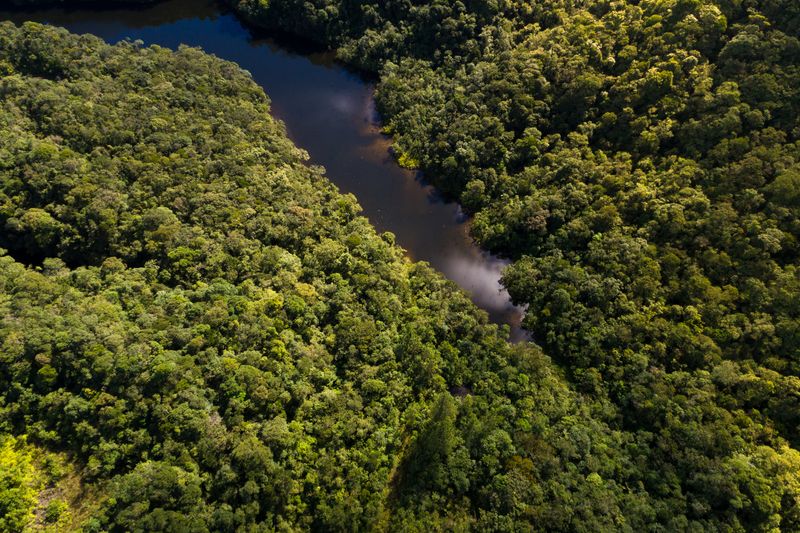
Across the tropics, each square metre of a forest could be contributing about 240 litres of rainfall yearly, underscoring why tropical forests need to be protected amidst increasing water and climate pressures, a new study has estimated.
Tropical forests help sustain a region’s and continent’s rainfall system through a process called ‘evapotranspiration’, where solar energy transfers moisture from leaves to the atmosphere. The rainfall so produced is critical for agriculture, water supplies and energy production.
Researchers, led by those from the UK’s University of Leeds, said they have put a monetary value on one of forests’ least recognised services as a source of rainfall to surrounding regions, with each hectare generating 2.4 million litres of rain each year — enough to fill an Olympic-sized swimming pool, they said.
The team combined satellite observations with climate models to address a long-standing uncertainty around the magnitude of forest-driven rainfall. A simplified economic valuation was then applied to estimate what the rain is worth to society and the economy.
“This is the most comprehensive and robust evidence to date of the value of tropical forests’ rainfall provision,” Jess Baker, from the University of Leeds’ school of earth, environment and sustainability and lead author of the study published in the journal Communications Earth and Environment, said.
“Tropical deforestation is increasing, despite international efforts to halt forest loss. Our work highlights the vital role of tropical forests in producing rain. We estimate that the Amazon alone produces rainfall worth USD 20 billion each year. Demonstrating the financial benefits that tropical forests provide will unlock investment and strengthen arguments for forest protection,” Baker said.
The researchers also estimated that deforestation in recent decades, which is around 80 million hectares in the Amazon, may have reduced rainfall-generation benefits by almost USD five billion annually, with knock-on effects for food production, hydropower and water security.
Further, producing enough rainfall to sustain major crops was found to require moisture generated by a forest area larger than area occupied by the crops themselves.
For instance, cotton uses 607 litres of moisture per square metre which is equal to the amount of water produced by two square metres of intact forest, while soybean crops need 501 litres of moisture — equal to 1.7 square metres of intact forest, the researchers said.
