
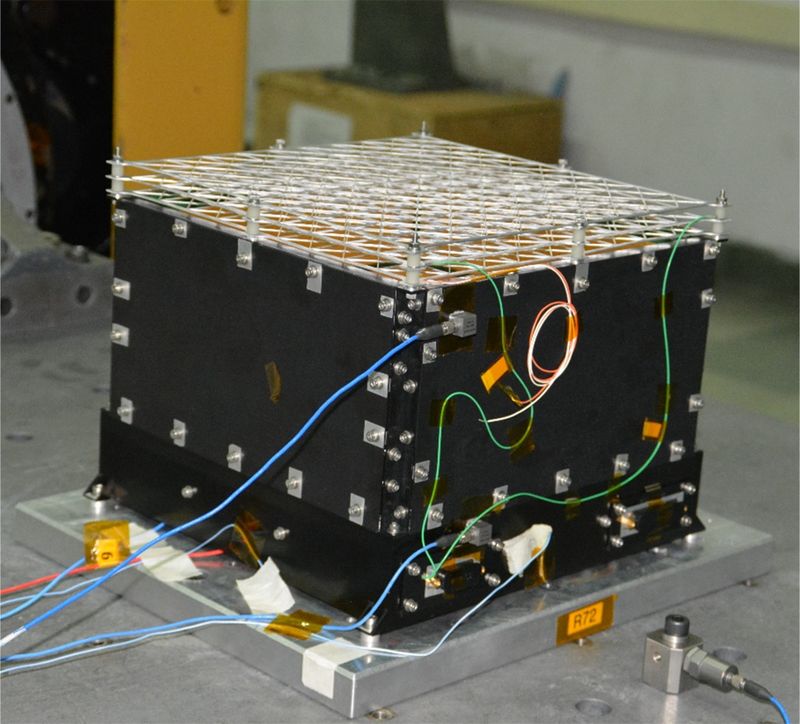
An orbital probe launched by the Indian Space Research Organisation (ISRO) has not only provided fresh insights into microscopic dust particles from outer space, but has also opened the door to conducting similar experiments in the uncharted environments around Venus and Mars.
Christened the Dust EXperiment (DEX), the probe registered a cosmic invader striking roughly every one thousand seconds, or about one interplanetary dust particle (IDP) hitting the probe every 17 minutes.
IDPs are microscopic shrapnel from comets and asteroids that form the earth’s atmosphere’s mysterious “meteor layer” and show up as “shooting stars” at night. “DEX delivered the most recent observations of IDPs entering Earth’s atmosphere. Definitive measurement of the dust flux is an exciting confirmation of the constant bombardment from outer space,” a statement by ISRO said.
“At present, we have no measurements of cosmic dust in the thick atmosphere of Venus or in the thin atmosphere of Mars. DEX is a blueprint of the detector which can study the cosmic dust particle at any planet having atmosphere or no atmosphere,” the space agency said.
The proven success of the Earth-orbiting DEX can provide the first-ever direct measurements of IDP within the uncharted atmospheres of Venus or Mars, but can also provide new measurements around the moon.
“Beyond pure science, this data is mission-critical. The ability to measure IDPs is essential for monitoring the space environment, precisely assessing hazards for our satellites, and ultimately, ensuring the safety and success of future manned missions to moon, Mars and beyond,” ISRO said.
Developed by the Physical Research Laboratory (PRL), Ahmedabad, DEX was flown on the PSLV Orbital Experimental Module on January 1, 2024, and rocketed to an altitude of 350 km.
The cosmic dust detector is the first Indian-made instrument to hunt for such high-speed IDPs. This compact instrument is tuned to “hear” impacts, capturing vital data that redefines our understanding of the universe and charts the path for safe human deep-space missions.
At the core of the experiment lies a 3kg dust detector based on the cutting-edge hypervelocity principle designed to capture high-speed space dust impacts with only 4.5 watts power consumption.
The 140 degree wide-view detector successfully logged signals of orbital debris’ impacts during January 1 to February 9, 2024, confirming the instrument’s capability to identify and measure such events.
