
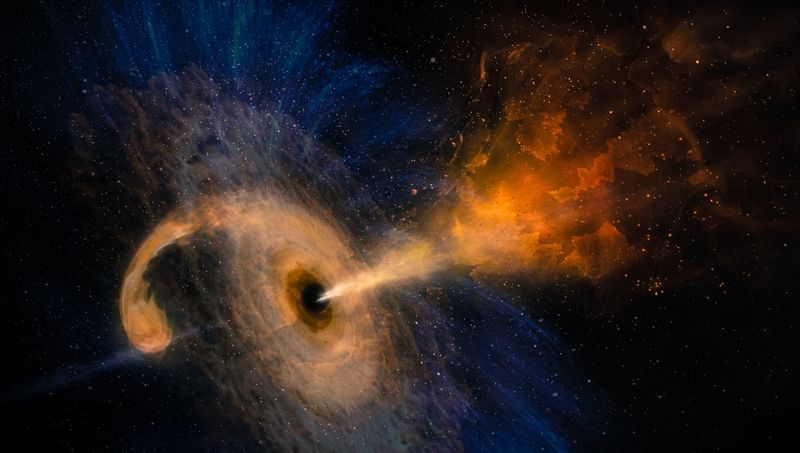
After five decades of trying, astronomers have finally discovered the wind emanating from the supermassive black hole at the center of our Milky Way galaxy, though it turns out it is more of a gentle breeze than a hurricane.
Using data from the Chile-based ALMA telescope and NASA’s orbiting Chandra X-ray Observatory, the researchers viewed the cosmic neighborhood around the black hole — called Sagittarius A*, or Sgr A* for short.
They spotted a vast conical cavity filled with hot, electrically charged gas adjacent to Sgr A* that they concluded was sculpted by wind blowing from the black hole that swept away or heated up the cold gas that had populated the region. They said the energy needed to create such a cavity could be generated only by a supermassive black hole.
Black holes are extraordinarily dense objects with gravity so strong that not even light can escape. Galaxies typically have a supermassive black hole at their core that pulls in gas and other material in its surroundings.
Scientists decades ago posited that any active supermassive black hole, due to its physics, would expel some gas and other material into space — either as a wind propagating outward or as a focused jet. They subsequently identified such behavior in numerous supermassive black holes in other galaxies, but until now had been unable to demonstrate that Sgr A* also did this.
“This discovery resolves a half-century-old mystery,” said Lena Murchikova, a professor of physics and astronomy at Northwestern University in Illinois and co-leader of the study published this week in the Astrophysical Journal Letters.
Sgr A* possesses about 4 million times the mass of our sun and is located about 26,000 light-years from Earth. A light-year is the distance light travels in a year, 9.5 trillion km. It is not as massive as some of its counterparts in other galaxies, and has been determined to be in a relatively quiescent phase.
The tip of the cone-shaped cavity arises from the immediate vicinity of Sgr A* and expands outward. While the researchers are not certain of the scale of the cavity because it reaches beyond the field of view of their observations, Murchikova said it could extend to about 6.5 light-years in length.
Because of the current docile state of Sgr A*, the wind it is generating is not as intense as witnessed with other supermassive black holes. Northwestern University astronomer and study co-leader Mark Gorski analogised its winds to Earth weather.
“It is a gentle breeze coming from our supermassive black hole. It doesn’t appear to be strong enough to drastically restructure the galactic center,” Gorski said.
“Supermassive black holes spend most of their time in this quiet, gentle state. However, sometimes they go through outbursts ranging from thunderstorms to the most violent of hurricanes. Their most intense winds or jets can completely disrupt their host galaxies and regions well beyond,” Gorski said.
As gas and other material spirals inward toward a black hole, it reaches close to the speed of light, creating enough energy and pressure to hurl some of it outward.
“While some gas keeps falling in, other gas is ejected. In fact, more of the gas is ejected than falls into the black hole.
This ejected gas is the wind we are talking about,” Murchikova said. “When we look at distant galaxies far-far away, it is much easier to see violent phenomena. We see huge, powerful jets ripping through the galaxy and everything else in their path. We see violent winds ejecting nearly all gas from their galaxies.” The difference between a jet and a wind is purely geometric.
“Jets are narrow and don’t expand very much as they leave their source, often producing a beam of matter. Winds, however, are wider and expand as they leave their source. It’s almost like the difference between a laser pointer and a flashlight,” Gorski said.
