
India’s first space-based solar observatory, Aditya-L1, has helped scientists discover that massive eruptions from the Sun do not spread uniformly through space, as previously believed. Instead, they expand unevenly, taking on irregular shapes.
The finding could help scientists better understand solar storms and predict their impact on satellites, communication networks and other space-based systems.
Scientists from the Indian Institute of Astrophysics (IIA), an autonomous institution under the Department of Science and Technology (DST), studied a solar eruption using observations from Aditya-L1, data from NASA’s Solar Dynamics Observatory (SDO) and computer-based three-dimensional modelling.
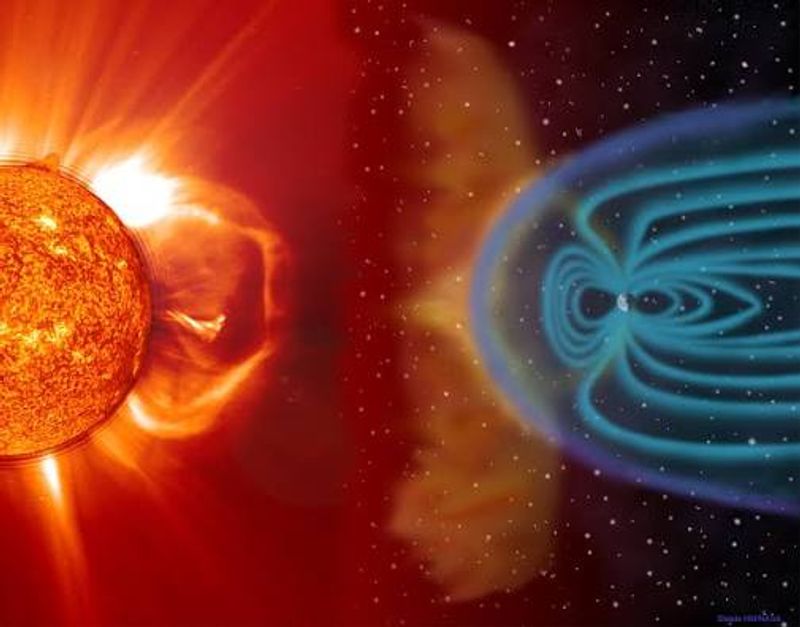
The study, published in the Astrophysical Journal Letters, found that a solar eruption, known as a coronal mass ejection (CME), does not necessarily expand like a perfectly round balloon. Instead, different parts of the eruption can move at different speeds, resulting in an uneven shape.
CMEs are massive bursts of charged particles and magnetic fields released from the Sun. When directed towards Earth, they can disturb its magnetic field and affect satellites, GPS services and communication networks.
The researchers studied a solar eruption that occurred on August 5, 2024, near the western edge of the Sun. They combined images captured by NASA’s SDO with observations made by the Visible Emission Line Coronagraph (VELC), the primary instrument onboard Aditya-L1.
While NASA’s telescope captured how the eruption moved across the sky, VELC helped scientists understand how the solar material was moving towards and away from the observers. This enabled the team to develop a three-dimensional picture of the eruption.
“We observed the CME that occurred on 5 August 2024 using the VELC as well as data from the Atmospheric Imaging Assembly (AIA) onboard NASA’s Solar Dynamics Observatory (SDO),” said Saurabh Tripathi, a PhD student at IIA and the lead author of the study.
The VELC observations revealed an unusual pattern in the light emitted by the eruption. Changes in the light indicated that some of the solar material was moving towards the observers, while other parts were moving away.
“Our results show that the CME did not expand uniformly. The AIA images captured how the CME propagated across the sky, while VELC revealed the motion of the expanding CME bubble towards and away from us,” said Tanmoy Samanta, a solar astronomer at IIA and the corresponding author of the study.
To understand this unusual movement, the researchers developed a three-dimensional computer model of the eruption.
“To understand the unusual spectral pattern observed by VELC, we then developed a 3-D geometric-kinematic model of an expanding CME,” said Jayant Joshi of IIA, a co-author of the study.
The team found that a model assuming uniform expansion could not explain the observations. However, a model in which the eruption was tilted and expanded unevenly towards its sides matched the actual observations.
Aditya-L1’s VELC studies these eruptions by observing green light emitted by highly heated iron atoms in the Sun’s outer atmosphere, known as the corona. This light helps scientists measure the speed of solar material by studying changes in its wavelength.
Launched in September 2023, Aditya-L1 is positioned at a point approximately 1.5 million km from Earth towards the Sun, known as the Sun-Earth L1 point. It carries seven scientific instruments and continuously observes the Sun.
