
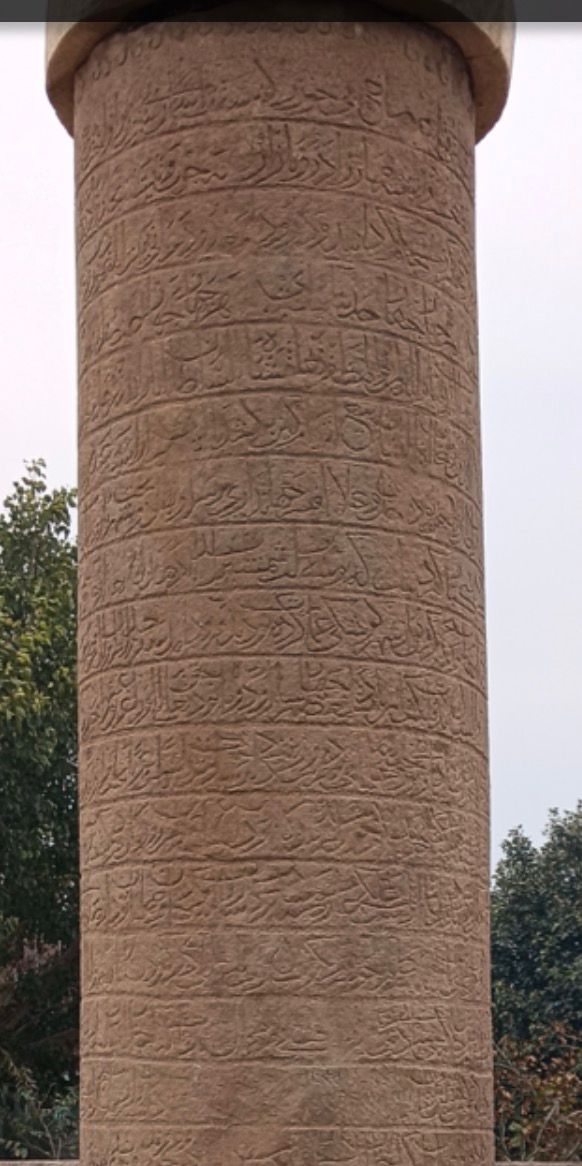
In a significant breakthrough combining history and modern technology, a team of Yamunanagar-based NGO, The Maitreya Trust, working to preserve Buddhist sites, have successfully deciphered a 700-year-old Arabic-Persian inscription on the historic ‘Fatehabad Pillar’ at Fatehabad, Haryana, using advanced Artificial Intelligence tools.
Sidhartha Gauri, the founder of The Maitreya Trust, who is working along with Satyadeep Neil Gauri and Raj Kumari, said that this was the longest Islamic pillar inscription in India.
“According to historians, around 2,300 years ago, this pillar was originally installed at Agroha and one half is close to the Masjid in Hisar Fort built by Firoz Shah Tughlaq, while the other half was at Fatehabad. The height of the pillar is a little less than 5 metres, and it measures 1.90 metres in circumference. The pillar is in two halves: the lower part comprises pale yellow sandstone of Ashokan times, and the upper part is of red sandstone added during the 14th century AD by Sultan Firoz Shah Tughlaq,” said Sidhartha Gauri.
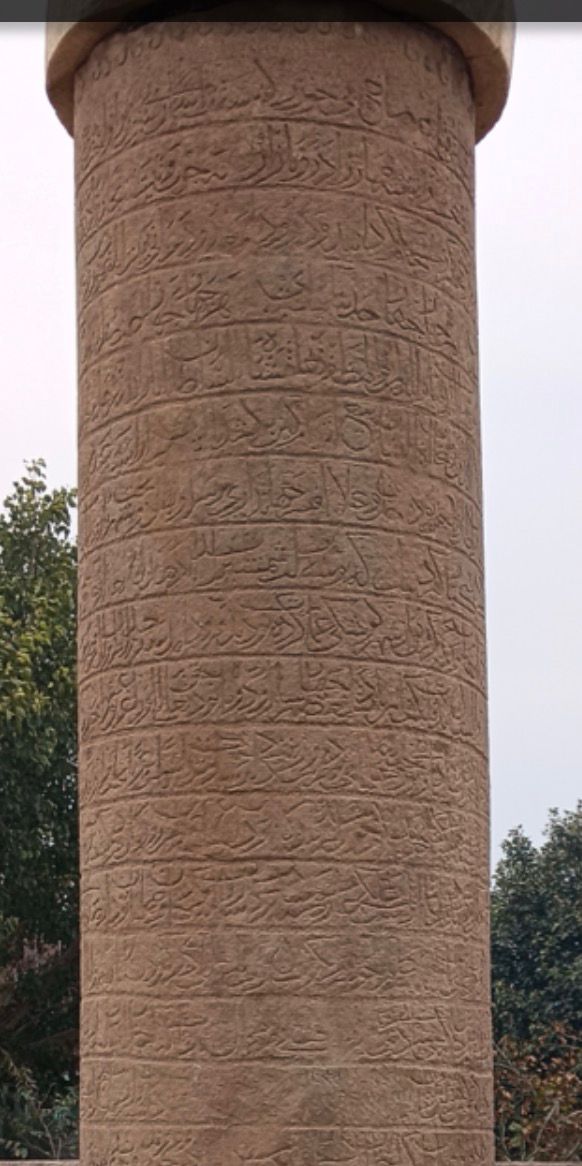
A close-up of the pillar.
Dr Neil Gauri, a practising dentist in Australia, said, “AI-assisted reconstruction enabled the joining of photographic segments, allowing accurate reading of the full circular inscription. After this, the inscriptions were highlighted in Gemini. All characters of the inscription became clear to read, which had become dull due to weathering and were rubbed due to man-made interference over time. After this, the inscription photos were transcribed into Arabic and Persian characters. For this, AI platforms such as Google, Gemini, and ChatGPT were used,” said Dr Neil.
Sidhartha Gauri further said that “Historical references support the findings: Alexander Cunningham, the first Director General of the Archaeological Survey of India, during his visit in 1863, and in 1883-84, Garrick of the Archaeological Survey of India provided a lithograph of it. In 1894, Paul Horn read many inscriptions of Hisar but again missed the pillar inscriptions,” said Sidhartha.
He said the breakthroughs achieved with AI were that the inscription was in Arabic in Naskh script and slightly decorative in Thuluth, while Persian was in Nastaliq script.
“Structural analysis revealed Line 1 and Lines 31-33 in Persian, and Lines 2-29 and 34-35 in Arabic. India is referred to as ‘Al Hind’. For the first time in the history of India, the transportation of the Ashokan pillar from Topra Kalan village (Yamunanagar district) to Kotla, New Delhi, has been stated. The inscription also highlights the zeal of Sultan Firoz Shah Tughlaq in promoting Islam over regional cultural sects of India at that time in history,” said Sidhartha.
He said that the testimony to check that the inscription had been rightly deciphered is by correlating it with an Iranian scholar who published the outlines of the pillar inscription in Corpus Inscriptionum Iranicarum by Mehrdad Shokoohy.
“The draft of the deciphered inscription is being sent to the Director and Deputy Director of the Haryana State Archaeological and Museum Department for further studies,” said Sidhartha.
