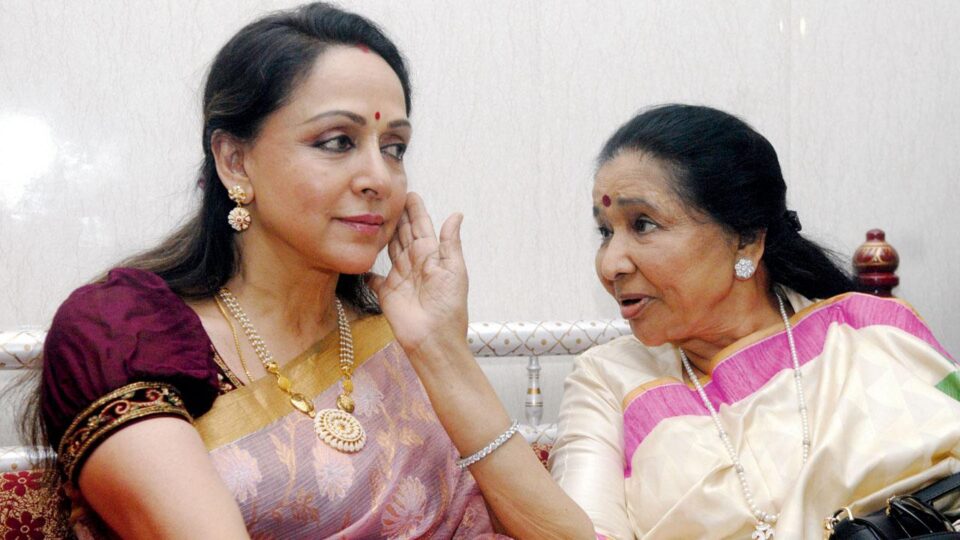
For me, Asha Bhosle was never just a voice behind the screen. She was an integral part of my performance, almost like a co-actor I could rely on completely. One memory that always stays with me is how easy it felt to step into a scene after hearing her sing. She would bring out every nuance, the expressions, the playfulness, and the emotion. It made my job so much easier. In fact, I would often feel that my performance became better because she had sung the song in such a perfect, expressive manner. I just had to follow that feeling, and it would naturally reflect on screen. I remember this song from Satte Pe Satta (1982), I couldn’t crack it until I heard her song and then I knew how to go with it. She would even call us to the studio when she was recording so we worked on the songs in tandem. Thus, the songs were so synced up.
Whether it was something lively like in Seeta Aur Geeta (1972) or a more character-driven song like in Khushboo (1975), she could adapt to every mood effortlessly. That versatility is something very rare. She could sing for a young girl, for a village character, for something classical, everything with the same ease and conviction. Offstage, too, she was just as wonderful. I truly feel that artistes like her are irreplaceable. Many singers have come and will come, but there was something about Ashaji, her range, her spirit, and her energy, that cannot be compared.
As told to Mohar Basu