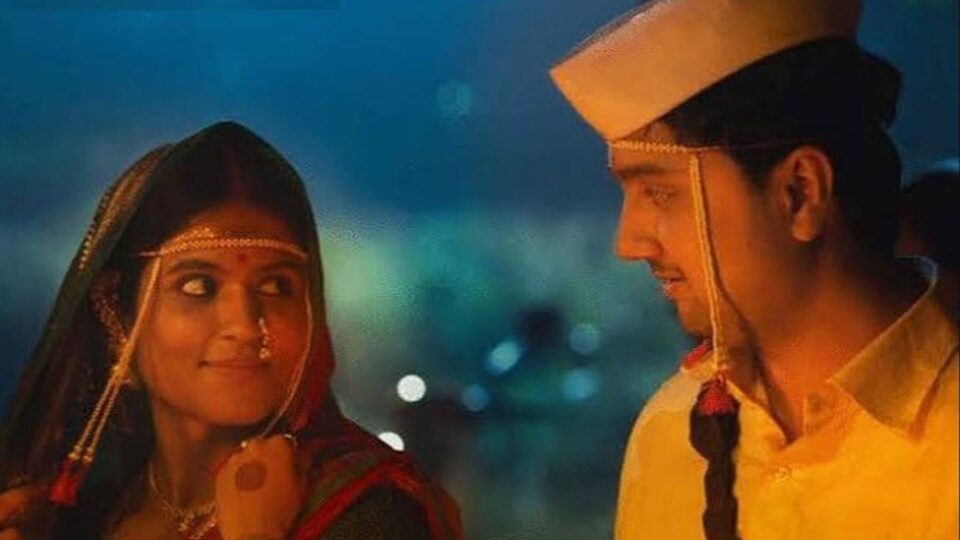
‘Gondhal’Dir: Santosh DavakharActors: Ishita Deshmukh, Yogesh SohoniRating: 2/5
Gondhal, from what I can figure from the film, is a nightly ritual in rural Maharashtra, performed at family gatherings and auspicious events, such as wedding ceremonies — that involves special poojas/prayers, stage performances, including roasting of prominent folk seated in the audience.
Gondhal, directed by debutant, Santosh Davakhar, is also India’s best film of 2026.
This, according to a jury constituted by the Film Federation of India — one of several film producers’ guilds — that gets to singularly pick the country’s official entry to the Oscars each year.
There can’t be anything right or wrong about such decisions. For a fact, the best merely means the favourite of a jury, as with any award. This Marathi film has, since, re-released in Indian theatres, dubbed into multiple languages.
I watched it in Hindi at its press preview, with the director in attendance, who spoke of currently campaigning in Los Angeles, I suppose, to secure a spot in the shortlist for the Best International Feature Film category Oscars, first.
To be sure, Gondhal starts off remarkably, with an opening sequence shot as an exceptionally long single take — as the camera flits between several characters, following their movements, and switching to another. Backdrops and actors change; the scene carries on.
The location, as in the setting, being a Maharashtrian village, and the cast — basically, the bride, groom, family, friends, locals, attending a marriage gondhal — is suitably established.
A general rule about art is that the more specific it is, the more universal it can potentially get. For, what’s a good movie if not travel — into spaces and cultures so separate from our own.
Frankly, I live in Maharashtra, but my own understanding of its rural life is sometimes almost as distant as an audience watching the same film in another country.
That said, certain aspects unite the rural Indian experience — no matter which other part of the country you’re more familiar with (UP, Bihar, Himachal, wherever).
This is besides the usual — a general lack of electricity, or the bhoj/community dinners on the floor, with patta/leaves for plates, and the inevitable ‘naraaz phuphaji’/upset uncle at a wedding.
And that’s the existence, as you notice, of a local chieftain-like patriarch, a Patil, in this picture’s case, who dominates through cruelty toward the have-nots.
That’s the figure, as per a line in the film, that people naturally submit to, “out of fear than respect”. The hierarchical oppression is complete.
There are also the young men folk, often loitering around, for whom wedding is the sole vent for a lifetime’s struggles with sexual frustration — the chances for landing a suitable girl still depend wholly on social or economic status alone.
It’s a trap.
Likewise, there’s the girl in this film, getting married off against her will — at least so far as the given groom is concerned. It’s equally made clear to her that once wedded, only her arthi/ashes can return from the sasural (in-laws’ home).
You observe these little, little things. You feel sufficiently drawn in. But once in, for the longest, at least I found myself tapping on my phone, wondering, “So, what; ab kya?” The performances are uniformly theatrical.
Yes, there is a plot. It’s to do with the bride, who’s a devious creature herself, playing her potential suitors. There is a sense of a timeless Shakespearean tragedy, with characters without morals, and deaths that appear altogether easy come, easy go.
But even this kicks in so late into the picture, and concludes as suddenly, that you wish for a heads up, instead.
I guess that’s what you call the battle of the bulge — a definite beginning, a proper end, but the middle so bloated that you eventually lose interest in how you started, and where you landed. You’re just bored out of your mind.
To be fair, Gondhal is still a great directorial debut. The filmmaking flourishes for a low-budget production, shot in seemingly natural light, set over a single night, are all there.
For a first-time producer, Davakhar’s managed to bring onboard Ilaiyaraaja to score the music. It’s the kinda fine entries that most states in India make for National Awards, and deservedly win in their respective languages. It is, no doubt, an original piece of work.
Sadly, my thoughts kept going back to the fact that it is India’s official entry to the Oscars, hence the year’s best film, after all. Of course, I shouldn’t be thinking of it. But I can’t lie either.
Given the choices on that front, over the past decades, have often oscillated between the bizarre (Jeans, Indian, 2018: Everyone is a Hero) to the baffling (Saagar, The Good Road, Chhello Show). Gondhal decisively belongs to the latter category.
Yet, the film’s had a lucky streak thus far — it’s the reason you might watch it — obviously, you wish it well!