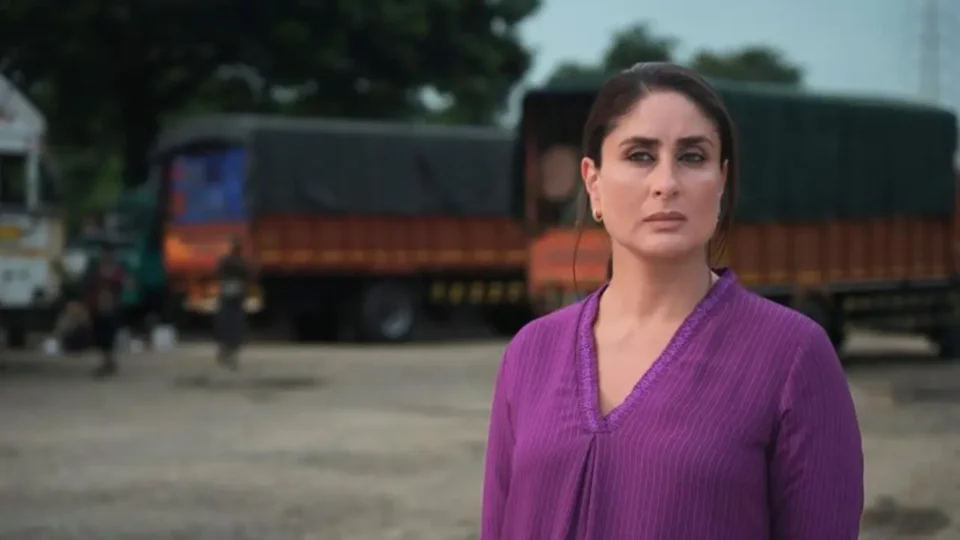
Director: Meghna Gulzar
Actors: Kareena Kapoor Khan, Prithviraj Sukumaran
Rating: 3 stars
For most part of the film, lead actor Kareena Kapoor Khan wears a slight smile, bordering on a smirk. In that sense, her treatment for the role seems very different from her last cop’s role in The Buckingham Murders (2024) that felt closer to Kate Winslet’s in Mare of Easttown (2021).
Meghna Gulzar’s Daayra is, equally, a grim suspense-thriller. Kareena, as a seasoned cop, inhabits a world that is what it is — India, in particular, as the cliché goes, is not for beginners.
Her know-all smile, hence, suggests the only way to navigate a labyrinthine system is not to be frustrated by it. Else, the system wins.
Her character is, in fact, reinvestigating a gangrape and murder case. Meaning, the probe was already complete. The convicts nabbed. They, however, died over what, on the face of it, appears to be extrajudicial killings — euphemistically known in desi police parlance, as ‘encounter’ deaths.
Kareena’s role, therefore, is to investigate the police itself, which is locally led by an IPS officer who is, service-wise, her peer.
Prithviraj Sukumaran plays the said local officer. Prithviraj, of course, has done a few Hindi films (Aiyyaa, Naam Shabana, Bade Miya Chote Miya). Daayra does greatest service to his obviously magnetic yet minimalist screen presence.
He’s a star from Malayalam cinema that, anyway, does minimalism better than most of India. It’s just unfortunate that top-tier Bollywood tends to draw A-list talents more from other southern film industries, particularly Telugu, where the leads are trained to deliver vapid, onscreen, hot-air heroism alone.
As a policeman, Prithviraj’s character seems convinced about the limitations of the law, with delivering clean and swift justice. Which makes him a ‘Singham’ of sorts.
But is he portrayed as the conventional, straight-up hero as movies of a certain ilk do? Well, not really. He’s not quite the convenient villain either. Meghna simply provides a counterpoint to the deeply commercial role. She seems to do this rather well.
In the same way that, perhaps, Meghna’s Raazi (2018) was a subtler riposte to what a spy-thriller can be, even while staying within the popular mainstream.
In terms of genre, Daayra is closer to Meghna’s Talvar (2015) — based on the infamous, 2008 Noida double-murder case — by way of putting the appointed investigators themselves on the dock, and stringing the story from thereon.
Except, in terms of going back and forth, from every angle, with new evidence and twists on the same event, Talvar had much stronger material to rely on, play with, and keep the audience sufficiently engaged, every step/second of the way.
That’s not so much the case with Daayra’s plot per se, which feels stretched, as a result.
As it is, a police procedural of this sort is, more so, the staple palette for the OTT/web series. And there have been some great ones, already.
Although it must be added that for its sheer detailing on an existing report/file, Richie Mehta’s Delhi Crime (2019) remains unmatched, still; notwithstanding its sequels that were hardly a patch on the original. It was a minute-by-minute account of Delhi’s 2012 ‘Nirbhaya’ case.
It gets strongly referenced in Daayra, which is set in 2019. The immediate parallel to draw, here, from the same year, is the ‘Hyderabad/Shamshabad veterinary doctor gangrape and murder’, aka the ‘Disha’ case. This picture is set in a generically fictional town named Suryapur in Teerthana (for Telangana), instead.
Here’s the thing, though. Whether or not they’ve read up on the said case — for a suspense drama, the audience is adequately made aware of what’s happened, already. As are all the characters. Even while Kareena’s cop probes the police concerned.
The loopholes of the investigation expose the callousness/rot in the system, prone to dilly-dallying and delays. Which, as the film rightly points out, would be way worse, if you were a have-not from the boondocks, hence hardly high-profile to be termed ‘India’s Daughter’.
It’s only when the picture makes its wider point that the interest piques again. Which is? To weigh in still on the rights and wrongs of vigilante-based poetic justice, delivered by the police, that holds monopoly over violence, under extraordinary circumstances.
And what are those exceptions, in the first place; who defines them, or polices the police then? Would you rather have a deeply flawed system than none at all; and yet, what good is a system, if it’s loaded against the victim?
Frankly, your sympathies on the matter could swing both ways. The issue is much larger than a particular, real-life event. I have an answer. You may have another. Glad the film asks the question, and leaves it at that.