
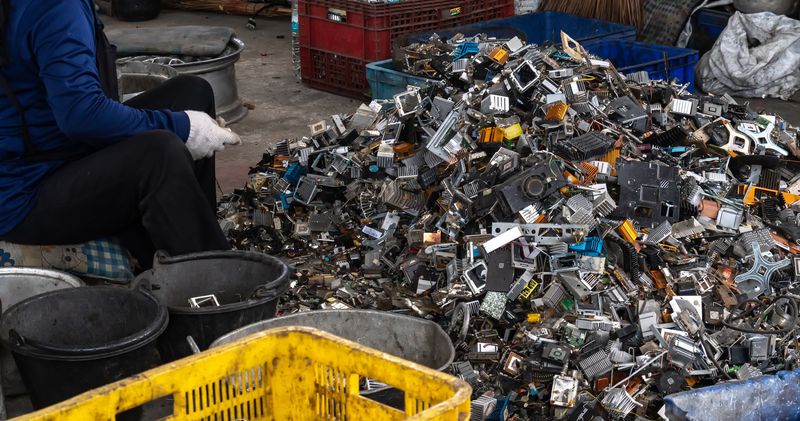
Significant structural gaps exist in India’s Extended Producer Responsibility (EPR) framework for e-waste management as it fails to capture a vast range of critical minerals essential for the country’s green transition, finds a new study by an environment think tank.
The study, titled ‘Long Road to Circularity’, by Toxics Link also underscored persistent issues, including low consumer awareness, poor financial traceability of e-waste flow, and limited monitoring capacities.
“The EPR framework mandates the recovery of only four metals — gold, copper, iron, and aluminium — leaving critical metals untapped. A vast range of valuable and critical metals, including neodymium, dysprosium, and lithium, are essential to strengthening resource security, but are currently overlooked and lost,” the report noted.
The study said the EPR portal currently lacks data on total market players and leaves small-scale manufacturers, online sellers, and grey-market importers outside the system.
“Information regarding non-compliance penalties and environmental compensation remains unavailable for the 2023-24 and 2024-25 fiscal years. Detailed data is accessible only to operators, resulting in limited public visibility into system performance. The current regulation does not identify and place responsibility on any individual stakeholder for setting up collection centres, thus making it extremely difficult for the consumers to deposit their waste in the authorised e-waste stream,” it said.
“While EPR is a cornerstone of India’s e-waste management framework, the principle alone cannot deliver the desired outcomes. It must be complemented by an effective and robust waste collection system, integrating the informal sector, and the development of high-tech recycling facilities along with public awareness for advancing system transparency,” Satish Sinha, Associate Director, Toxics Link said.
The report suggested enhancing system accountability and transparency by making data accessible to the public, strengthening reverse supply chains and collection mechanisms to streamline the flow of e-waste, expanding consumer awareness on the advantages of e-waste recycling, and the importance of using authorised collection channels.
“Integrate the informal sector into the e-waste management ecosystem. Together, these measures can help build a stronger and more effective e-waste management system,” the report added.
