
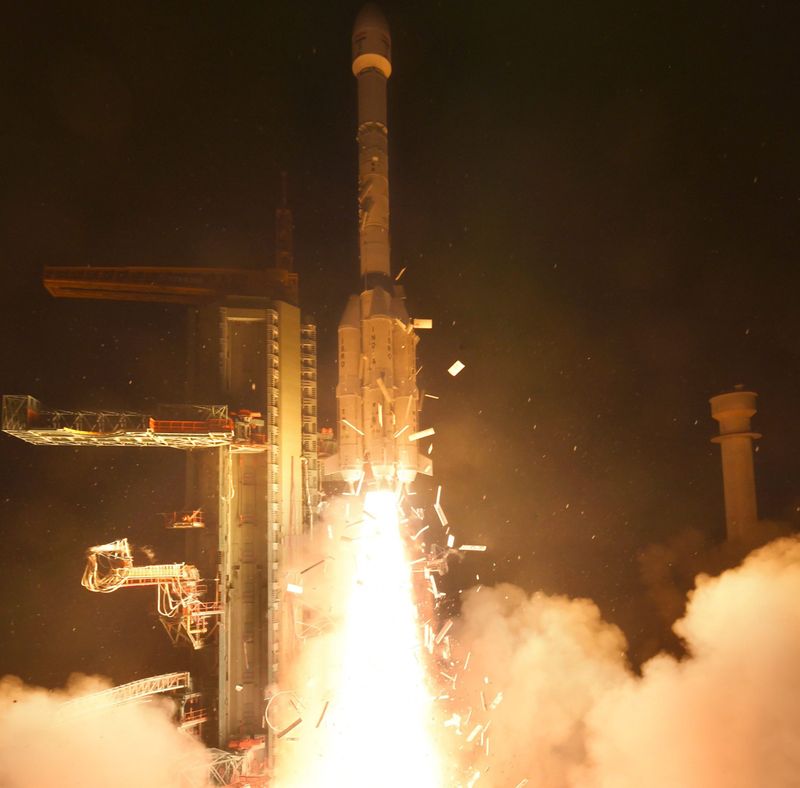
India on Friday successfully launched EOS-05, its first imaging satellite designed to operate from a geosynchronous orbit, marking a major technological leap for the country’s Earth-observation programme and giving ISRO a morale boost after its first orbital mission of the year ended in failure.
Prime Minister Narendra Modi hailed the GSLV-F17 mission as an “outstanding achievement”, while Congress leader Jairam Ramesh congratulated ISRO but used the occasion to question what he called a “radical role reconfiguration” of the space agency at the instance of the Prime Minister’s Office.
The 51.7-metre-tall GSLV-F17 lifted off from the second launch pad at Sriharikota at 2.55 am, carrying the 2,367-kg EOS-05. The rocket subsequently placed the satellite in its intended sub-geosynchronous transfer orbit.
EOS-05 was injected into an orbit with a perigee of 171 km, an apogee of 31,026 km and an inclination of 19.28 degrees. A series of manoeuvres using onboard thrusters will now take it to its final orbit.
The mission assumes significance as EOS-05 is India’s first imaging satellite meant to operate from geosynchronous orbit. Most of India’s operational Earth-observation satellites have been deployed in low-Earth or sun-synchronous polar orbits. Its existing geostationary Earth-observation capability includes the INSAT-3D series of meteorological satellites.
“Yet another outstanding achievement by ISRO and a proud moment for our nation,” Modi said, describing the mission as a reflection of the “excellence, innovation and growing capabilities” of India’s space sector.
The Prime Minister also pointed to the increasing partnership between ISRO and Indian industry, saying it was adding “new strength and scale” to the country’s space programme.
Friday’s flight was the 19th mission of the GSLV and the first since GSLV-F16 placed the joint NASA-ISRO NISAR satellite into a 743-km sun-synchronous orbit in July last year.
It was also ISRO’s second orbital launch of 2026. The PSLV-C62 mission carrying EOS-N1 and other payloads on January 12 had failed following an anomaly towards the end of the launch vehicle’s third-stage flight.
Ramesh called the latest mission a “landmark achievement” that would add to India’s strategic capabilities.
“The entire nation should salute ISRO’s deep resilience and wish it all success in coming endeavours,” he said.
The Congress leader, however, struck a cautionary note over the future of the agency, saying ISRO had made the country proud for decades despite “tremendous odds”.
He alleged that a “radical role reconfiguration” was taking place at the instance of the PMO, which, he said, “will change the very character of this inspirational public institution”.
The three-stage GSLV-F17 used an indigenous cryogenic upper stage for Friday’s mission.
