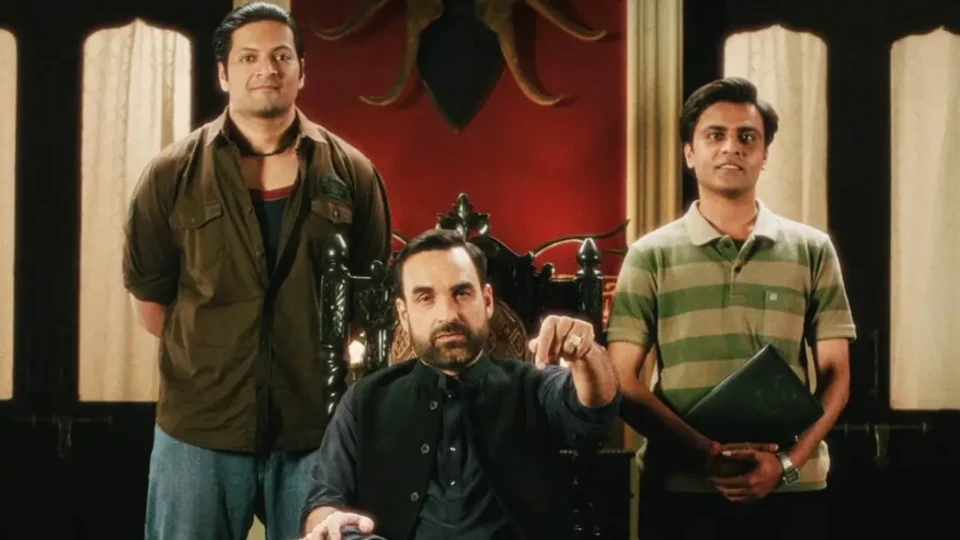
Mirzapur: The MovieDirector: Gurmmeet SinghActors: Pankaj Tripathi, Ali Fazal, DivyennduRating: 3/5
It’s rare that a film’s character does context-setting for the others in a way that the dialogue reads like the film’s review itself.
In Mirzapur: The Movie, you notice that with Bablu (Jitendra Kumar), pontificating over his brother, Guddu (Ali Fazal), and young don, Munna (Divyenndu) — both of whom have their guns pointed at each other in a frantic scene.
Bablu patiently explains that Guddu and Munna are, in fact, two versions of the same person — they’re “lanth” (trigger-happy hot heads), seeking validation from their respective fathers, and who love their moms devotedly.
Munna is Don Kaleen Bhaiya’s (Pankaj Tripathi) son, while Guddu’s the same Purvanchal mafiosi’s chief henchman. Munna’s mother’s no more. He has a scheming step-mom (ravishing Rasika Dugal), with shades of Lady Macbeth.
Likewise, Guddu’s got an ally for a mother (super-sweet Sheeba Chadha), while his honest father (Rajesh Tailang) can’t stand his guts. Both Bablu and Guddu also have love-interests (Shriya Pilgaonkar, Shweta Tripathi).
You already know most of this — having watched at least the first season of the Amazon Prime Video series that Mirzapur is, primarily, the movie version of.
In fact, the cast of characters in this film is so bloody wide that each person, including the protagonist, Kaleen Bhaiya himself, can barely make a cameo to explain their presence in the script. Even their basic intros could take longer than most features. Mirzapur is already 197 minutes long. Phew!
What this level of existing background and, hence, the storytelling does — instead of story yelling, and senseless killings, far more common with similar actioners from the South — is it makes the characters count for something.
So do their deaths. You can’t just ‘daago’/inflict, and move on.
There’s a scene, where Kaleen Bhaiya is asked to attack his rival dons, conspiring their next move, nearby. He mutters, “Saari praja ko maar denge toh raj kispe karenge (If we kill everyone, who will we rule over?).” This matters.
The picture’s purpose is equally known. Which is to survey the absolutely fictionalised Uttar Pradesh town called Mirzapur — I’m told, the actual Gorakhpur is closer to its reality — wherein the battle is for “varchasv”/domination of its underworld. Why’s this seemingly significant?
As we are told, the route to political power flows precisely through these badlands: Mirzapur -> Purvanchal -> Lucknow -> New Delhi -> India.
Pure jungle laws operate. You observe not a single cop in action. At the ground level, upper castes — Tripathi, Shukla, etc — reign supreme. In electoral politics, there’s indeed a Yadav rule.
It’s not important whether the said ferocity and flowchart is idiotic. It’s important that this gives the setting the playground to field multiple curios for characters, and many of them so innately loved.
Some of them, stars, in their own right. You’re already familiar with the world. You never question, while reinhabiting it.
Within the crowded space, the filmmakers — particularly the excellent writer, Puneet Krishna — do well to create space for fresher parts still, namely, the villain, i.e. Ravi Kishan; even a fun, casual encounter with a rando kid named Chandu Puncture. This denotes conviction. They aren’t overwhelmed by their own material.
Whatever you may think of Kishan, a politician himself, there’s something about his onscreen presence that feels so deeply earthy — it’s hard not to be drawn to his naturally rustic/dehati demeanour.
But the fellow you can’t take your eyes off, still, is Ali Fazal as the good ol’ Guddu Bhaiya; too good to be true. This adorable Big Moose, with a bird brain, seems so much like Hulk that if Mark Ruffalo ever stepped out of Marvel, Fazal must audition for the spot! Another way to go could’ve been a spin-off with Guddu at the centre.
That said, why was a movie necessary, when we’ve been through three seasons of the OTT series — and what’s the difference, anyway? I suspect, even if it’s OTT — more like film — the medium remains TV; chewing gum of the mind, if you will.
What do I instantly recall from the three Mirzapurs? Over so many years, even now, genuinely, its opening mad-action sequence.
That’s the thing with novelty; it sticks forever. Everything else thereafter wears off, slowly, but surely. The movie similarly starts off with a shootout at a masala factory.
As it is, the genre is big-screen staple. And gigantic myths get created in the movie theatre, foremost. Does Mirzapur, the movie, take it to that next level, so to say? Does Kaleen Bhaiya, for instance, glide towards The Godfather? I’m afraid, no.
For the way it’s shot, edited, narrated, Mirzapur: The Movie feels, for the most part, like a mini-series for the big screen. And so be it.
That’s how I watched it — legs up, rested on sasta theatre seat in front of me — following scene after scene; naturally, a fine performance after another.
Up until a point that it appeared the simple story had overstretched its welcome, with Bollywood stunts, and the sorts. What with the closing slate done, and a whole lot more yet to go!
Would I’ve preferred a lazier recliner, instead? Hell, yeah. If that’s my only regret from this picture, that’s not bad at all.